
Cureosities | Thoughts on Employee Engagement

Employee engagement is declining again; this is clear. Gallup’s latest research shows that engagement in the United States has dropped to a 10-year low, hovering just above 30%. At the same time, employee wellbeing is shifting in a concerning direction. For the first time in Gallup’s tracking, more employees report struggling than thriving, with thriving falling from 53% to 46% (Sources that are great reads: Gallup Engagement and Gallup Thriving). The decline itself is not the most important part of the story. What matters more is where that decline is happening. Engagement is falling most sharply among managers, the group responsible for shaping team culture, guiding performance, and translating company goals into daily experience. At the same time, employees who are in the office full time are reporting lower engagement than their hybrid counterparts, a signal that being present in the workplace is not enough to create connection, meaning, or motivation.
These two shifts are deeply connected. Managers carry the weight of organizational expectations while often operating in systems and environments that have not evolved to support how people work today. In addition, employees who are asked to be in the office full-time are often returning to spaces designed for a different era, spaces that do not reflect why they are there in the first place. Engagement does not disappear on its own. It erodes when something fundamental is out of alignment, when leadership expectations, employee experience, and the built environment are no longer working in concert. For years, organizations have tried to solve engagement through programs, perks, and policy. Those efforts are not without value, but they often treat engagement as something to be managed rather than something to be developed. That distinction matters because engagement is not a metric. It is a state of being.
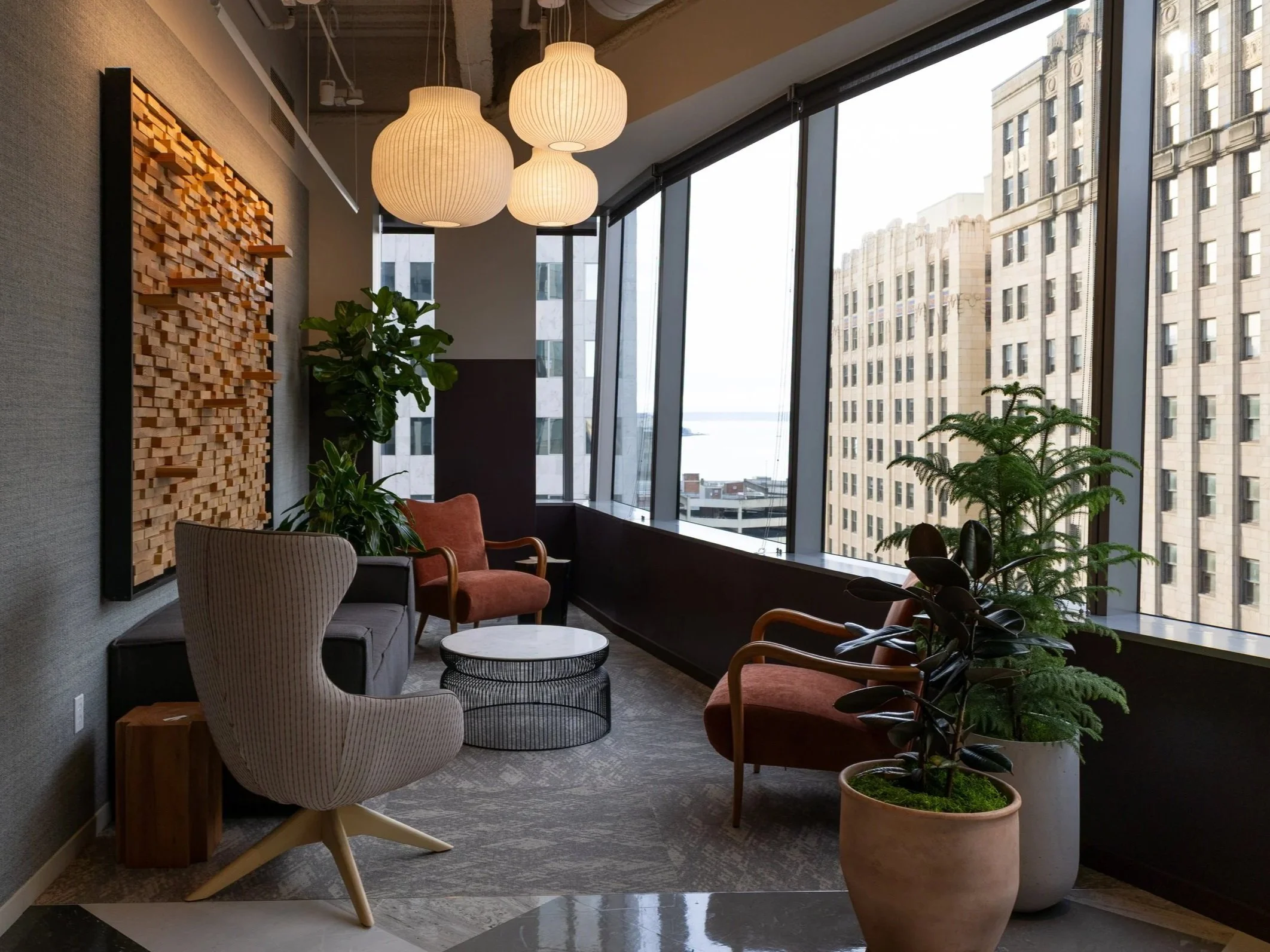
Soft, in-between spaces that provides options for workspace in addition to acknowledging the importance of social connections.
Engagement emerges when people feel connected to their work, to the people around them, and to a shared sense of purpose. It is the outcome of an environment - cultural, operational, and physical - that supports people in doing their best work. This is why engagement matters so deeply to organizations. It is not just about morale. It is directly tied to performance. Gallup’s research shows that highly engaged teams experience significantly higher productivity and profitability, stronger retention, and better overall business outcomes. In contrast, disengagement introduces friction into every part of an organization, slowing decision-making, weakening collaboration, and ultimately limiting growth, both organizationally and individually. In that sense, engagement is not a “people issue.” It is a business imperative. Unfortunately, the way many workplaces are designed today does not reflect that reality. While we all know that the post-pandemic office has different needs, the understanding is that the office has to function differently for this post-pandemic world, but in not really knowing what that means, many office environments are still being built using outdated perspectives and prototypes. Focused work can happen anywhere and often happens more effectively outside the office. When people choose to come in, they are not coming for a desk. They are coming for interaction, collaboration, and a sense of connection. Yet, many workplaces remain organized around rows of desks that sit partially empty, asking people to return to a model that no longer serves them. This is where the disconnect becomes tangible.
At Cureo, we think about the workplace not as a container for work, but as a framework for experience. People do not engage with square footage. They engage with how a space makes them feel, how it supports them, and how it connects them to others. If the purpose of the office has shifted toward connection, then the design of the office must shift with it. Some of the most meaningful interactions in a workplace do not happen in formal meeting rooms. They happen in the margins, in the spaces between, along circulation paths, in shared amenities, in moments of pause. These are the places where relationships form and ideas begin, where “weak ties” are built and creativity takes shape. Unfortunately, these spaces are rarely the priority. Instead, they are often residual thoughts, what is left over after “efficient” planning is complete. And in doing so, we unintentionally minimize the very experiences that drive engagement.
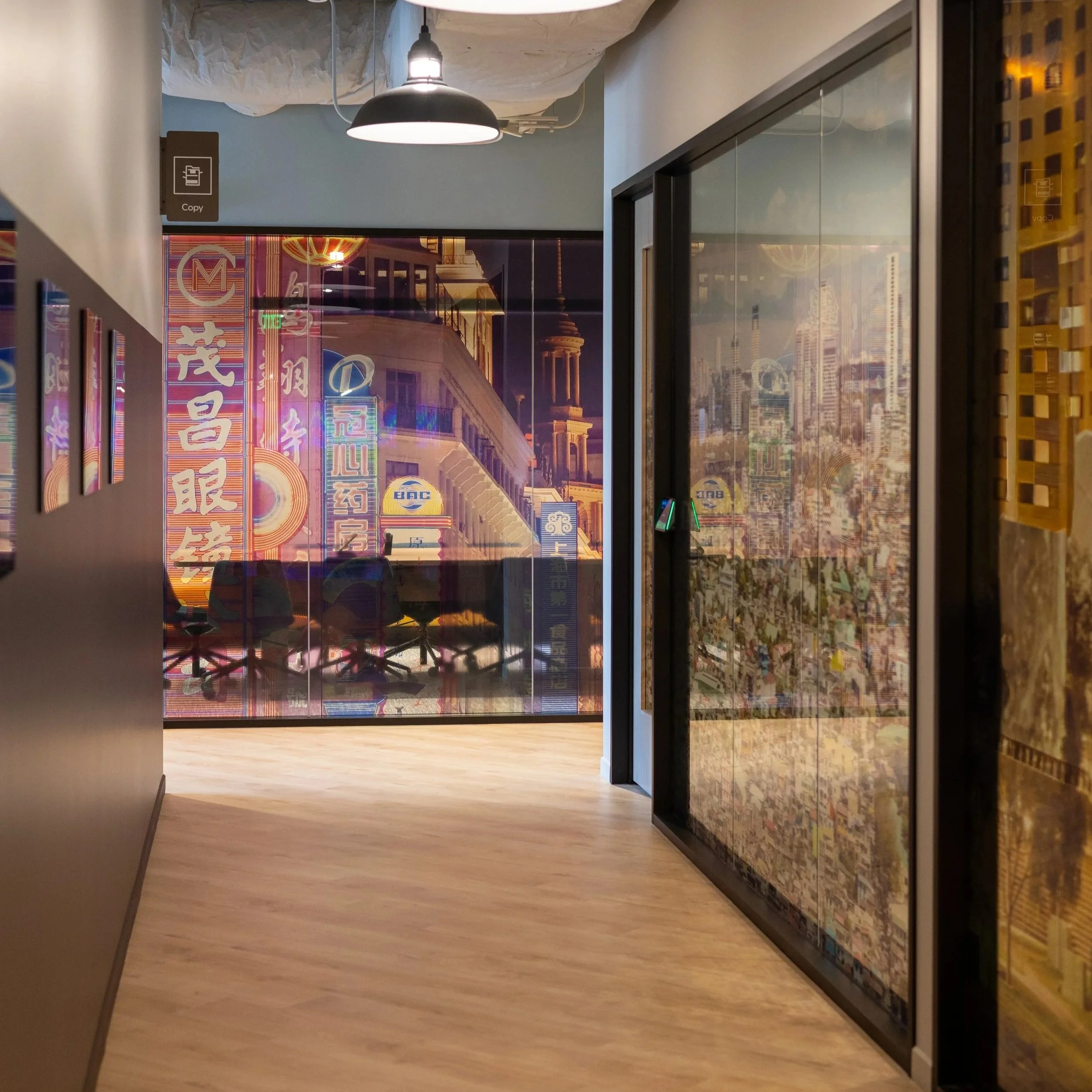
Space with layers of graphics and art that connect employers to company culture and end-users.
Choice plays a similarly important role. When people are given a range of environments to work within, such as quiet spaces for focus, open areas for collaboration, informal settings for conversation, they are able to navigate their day in a way that aligns with how they think and work best. But beyond function, choice communicates trust.It signals that employees are not being managed through visibility but supported through intention. It acknowledges that autonomy matters, and that trust is a foundational component of engagement. For managers, in particular, this becomes critical. If managers are the primary drivers of engagement, yet they themselves are disengaged, then the system begins to break down. Supporting managers is not just about leadership training. It is about creating environments that reduce friction, support collaboration, and make it easier to lead effectively. The physical workplace can either amplify that effort or work against it. There is also an emotional dimension to consider. People do not engage with environments that feel sterile or generic. They engage with spaces that feel human. Natural light, material warmth, comfort, acoustics, and scale all contribute to this experience. These are not purely aesthetic choices. They shape how people feel in a space, and how people feel directly influences how they show up.
In a world where home has redefined comfort and control, the workplace is not compared to other offices. It is compared to personal experience. If it falls short, people disengage, regardless of how often they are asked to be there. Belonging follows a similar pattern. It is often discussed as a cultural objective, but it is also something people assess physically. They look for cues in their environment, asking whether they fit, whether they feel comfortable, and whether there is a place for them. A workplace that supports belonging offers variety, reflects identity, and accommodates difference. It allows people to show up as themselves, rather than conform to a single way of working or being. When that happens, engagement becomes more natural and less forced.

Workspace that provides supporting technology and infrastructure as well as natural lighting and thoughtful materiality for employee well-being.
Most organizations already understand what drives engagement. The data is not unclear. Leadership matters. Clarity matters. Recognition matters. Connection matters. The challenge is not knowing. It is aligning - Aligning what we say we value with what we actually build. Aligning how people work with where they work. Aligning the expectations placed on managers with the environments they are given to operate within. It is clear that when those things are out of sync, people feel it. And when people feel it, engagement declines.
So the question is not how to fix engagement. The question is whether we are willing to rethink the conditions that create it. The decline in engagement is not just a problem to solve. It is a signal that people are asking for something different, that the workplace, as it has been traditionally defined, is no longer enough. Perhaps most importantly, a signal that experience, not efficiency, is what drives performance. The organizations that will thrive are not the ones that chase engagement scores or mandate presence. They are the ones that design for people, intentionally, empathetically, and holistically because when people feel connected, supported, and understood, engagement is not something you have to demand. It is something that shows up on its own.